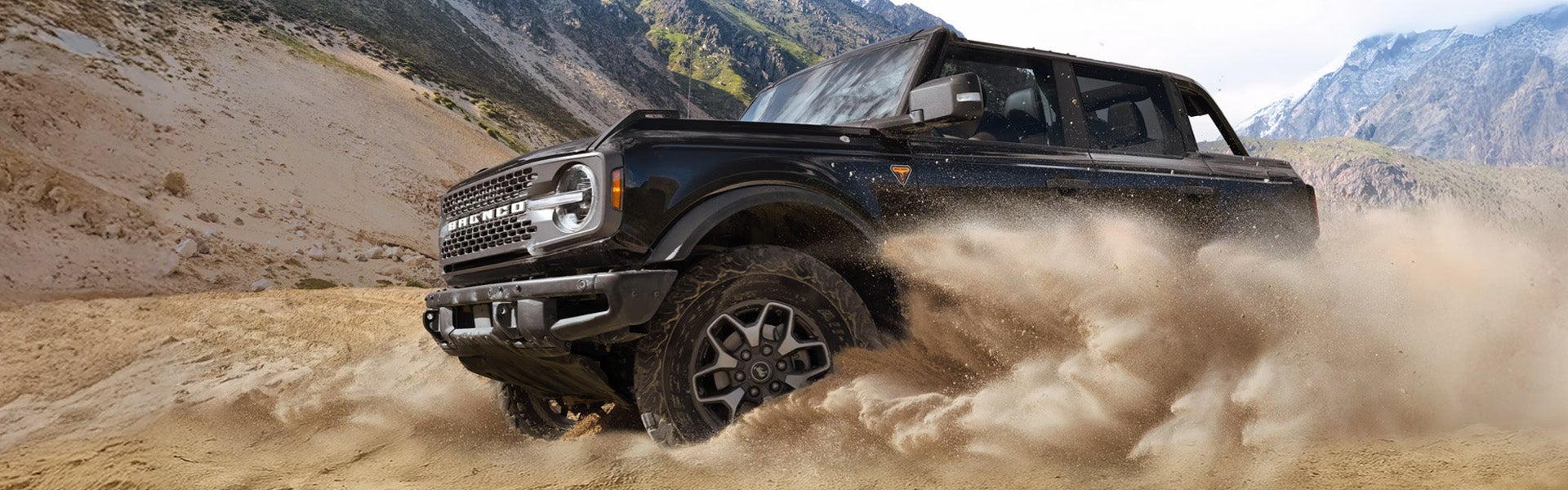
The Ford Bronco® and Bronco Sport® share a family resemblance, but underneath their rugged styling are two distinctly different vehicles. One is a traditional, body-on-frame SUV engineered for demanding off-road excursions. The other is a compact crossover that balances trail capability with the conveniences of conventional SUV ownership. Both feature standard 4x4, yet their differences extend well beyond size. For drivers around Lakeview, OR, choosing between them depends largely on how far they intend to venture beyond paved roads.
Two Approaches to SUV Engineering
The Bronco® employs body-on-frame construction, an independent front suspension, and a solid rear axle. Available in 2-door and 4-door versions, it seats 4 or 5 passengers depending on configuration. Removable doors and roof panels deliver an open-air experience few SUVs can match. The Bronco Sport® takes a different approach with unibody construction, four conventional doors, a fixed roof, and seating for 5. Its smaller footprint makes parking and maneuvering easier, particularly for owners who spend more time in town than on remote trails.
Engine Choices Reveal Their Different Missions
The Bronco® offers three turbocharged engines. Its 2.3L EcoBoost® 4-cylinder develops up to 300 hp and 325 lbs. ft. of torque on premium fuel. The available 2.7L EcoBoost® V6 increases output to 330 hp and 415 lbs. ft. of torque, while the Bronco Raptor® uses a 3.0L EcoBoost® V6 producing 418 hp and 440 lbs. ft. of torque. A 10-speed automatic is available throughout the lineup, with a 7-speed manual offered alongside the 2.3L engine.
The Bronco Sport® offers a 1.5L EcoBoost® 3-cylinder generating 180 hp and 200 lbs. ft. of torque. Badlands® models receive a 2.0L EcoBoost® 4-cylinder with 250 hp and 280 lbs. ft. of torque. Both use an 8-speed automatic transmission. The larger Bronco® offers greater performance potential, while the Sport's powertrains suit its smaller dimensions.
Off-Road Hardware Makes the Difference
Both SUVs feature G.O.A.T. Modes® terrain management, but the Bronco® has the advantage when conditions become severe. Available locking front and rear differentials, a disconnecting front stabilizer bar, specialized HOSS suspension systems, and 35-inch tires provide equipment for negotiating substantial obstacles.
The Bronco Sport® counters with available Advanced 4x4 and a twin-clutch rear-drive unit. Badlands® models feature HOSS 2.0 suspension, all-terrain tires, and 7 G.O.A.T. Modes®, including Rock Crawl and Rally. With the available Sasquatch® Package, Badlands® ground clearance reaches 9.3 inches. That's considerable capability for a compact crossover, though the Bronco® offers greater clearance and more specialized hardware in select configurations.
Towing and Cargo: Consider What You're Carrying
Most properly equipped Bronco® models can tow up to 3,500 lbs., increasing to 4,500 lbs. for Bronco Raptor®. The Bronco Sport® reaches 2,200 lbs. with its 1.5L engine and available Class II Trailer Tow Package, or 2,700 lbs. in Badlands® configurations with the 2.0L engine.
The Bronco Sport® offers up to 65.2 cubic feet of cargo capacity in select configurations. A 4-door Bronco® provides additional cargo flexibility, although roof selection and equipment influence available space. Buyers should consider trailer weight and cargo requirements before selecting either vehicle.
Modern Technology in Both Cabins
Both models feature SYNC® 4 with wireless Apple CarPlay® and Android Auto™ compatibility. The Bronco® includes a 12-inch touchscreen, while the Bronco Sport® provides a 13.2-inch touchscreen and an 8-inch digital instrument cluster. Ford Co-Pilot360® driver-assistance features vary by trim and package. Neither model offers BlueCruise hands-free highway driving.
Compare Both at Hall Motor Company Ford
The Bronco® is the stronger choice for demanding trails, open-air driving, and specialized off-road equipment. The Bronco Sport® offers considerable capability in a more compact, conventional package. Visit Hall Motor Company Ford in Lakeview, OR, to compare available configurations and equipment. Schedule a test drive to discover which SUV better matches your driving habits and outdoor ambitions.